
![7 Best VPN for Buffalo [year]: Fast Servers for Buffalo IP](https://vpntrends.org/wp-content/uploads/2025/02/Best_VPN_for_Buffalo.jpg)

Buffalo, New York sits in a unique spot on the map: close to the Canadian border, close to major Northeast corridors, and often used as a “travel hub” for cross-border trips, conferences, and weekend travel. That means a “Buffalo VPN” is rarely about one thing. It’s usually about choosing the right setup for how you actually use the internet: home Wi-Fi, public Wi-Fi, travel, and occasionally “home-region” consistency when you cross borders.
A VPN can be useful for two core reasons. First, it adds a privacy layer by encrypting traffic between your device and the VPN server (especially valuable on shared networks). Second, in some travel scenarios it can help you keep a more consistent “home-region” experience when apps and services behave differently by country or network. However, streaming platforms enforce licensing rules and can block VPN/Smart DNS connections at any time.
Important: A VPN does not guarantee access to any specific streaming platform or content library. Availability can change over time. Always comply with local laws and the terms of service of the platforms you use.
What makes Buffalo different (and why it changes your VPN plan)
In most cities, “use a VPN” simply means “connect to a nearby U.S. server and go.” In Buffalo, the border factor changes the plan. Many users:
- move between U.S. and Canada for travel, work, or weekend trips,
- use hotel and event Wi-Fi more frequently,
- care about keeping a “home-region” experience while traveling,
- sometimes need to avoid inconsistent routing by picking smarter server exits.
In practice, you have three viable approaches:
- Always-on VPN on your daily devices: best for commuters, public Wi-Fi, and routine privacy.
- Router VPN (whole-home): best if you want your entire household covered without per-device apps.
- Travel/border setup: best if you regularly cross the border and want a predictable “home-region” connection strategy.
This guide is structured around those three approaches. Instead of starting with a “top VPN list,” we first decide which architecture matches your routine. Only after that do provider choices matter.
Quick picks (best for)
- Best overall daily-driver: ExpressVPN
- Best all-rounder: NordVPN
- Best for beginners: CyberGhost
- Best value + many devices: Surfshark
- Best for advanced setups: Private Internet Access (PIA)
- Best for privacy-first users: ProtonVPN
- Best for bypass-focused networks: VyprVPN
Start with the decision: which VPN setup fits your Buffalo routine?
Use this as a practical decision map. Pick the first condition that matches your reality.
If you often use public Wi-Fi (cafés, arenas, hotels, conferences)
Choose: Always-on VPN on phone + laptop.
Why: the biggest day-to-day risk is exposure on shared networks, especially during reconnects and captive portals.
If you want your whole household covered (TVs, consoles, guests)
Choose: VPN on your router.
Why: once configured, it is “always on” for every device on that Wi-Fi/Ethernet network.
If you regularly travel across the U.S.–Canada border
Choose: A simple “home-region strategy” + a shortlist of U.S. and Canada servers.
Why: the goal is predictability: stable endpoints, fewer app/location surprises, and quick fallbacks if one server is congested.
Most Buffalo users end up with always-on device VPN (for mobility) or a router VPN (for whole-home coverage). The border/travel strategy becomes important when you cross into Canada often or spend time on hotel Wi-Fi.
How we evaluate VPNs for Buffalo (methodology)
We focus on what matters for Buffalo’s real-world patterns: cross-border travel, network switching, and speed stability.
- Speed stability: consistent throughput for HD/4K streaming and video calls.
- Nearby server coverage: enough U.S. East + Canadian locations to avoid congestion and test alternatives.
- Protocol support: modern protocols often reduce overhead and improve stability.
- Privacy controls: DNS leak protection and a kill switch that behaves predictably.
- App reliability: fast reconnects, stable long sessions, and good behavior on captive portals.
- Provider transparency: clear policies and technical documentation, not just marketing claims.
Performance reality: what your VPN must handle in Buffalo
In Buffalo, “speed” is best treated as a stability budget. Your connection quality changes with congestion, server choice, and travel networks.
Practical performance rules:
- HD streaming: stability matters more than peak speed.
- 4K streaming: you want consistent headroom, not “exactly enough.”
- VPN overhead: encryption and routing add overhead; the closer the server and the better the protocol, the less overhead you feel.
Where do problems usually originate?
- Server distance: far-away endpoints increase latency and raise the risk of throughput variance.
- Congestion: some servers slow down at peak hours; having alternatives matters.
- Network switching: captive portals and Wi-Fi roaming can break tunnels if reconnect behavior is poor.
Setup Path A: Always-on VPN on your phone + laptop (Buffalo daily-driver)
This is the most common Buffalo setup because it protects you across cafés, events, hotels, and travel.
Step 1: Enable kill switch and leak protection
Use a provider that supports kill switch and DNS leak protection. This reduces accidental exposure if the tunnel drops or reconnects.
Step 2: Use a nearby U.S. server for everyday use
For privacy-only usage, choose a nearby U.S. server to minimize overhead. Testing 2–3 nearby endpoints is often more valuable than chasing “fastest” labels.
Step 3: Save a shortlist of stable servers
Keep a shortlist of 2–3 servers that behave well during peak hours. This is one of the simplest long-term optimizations.
Setup Path B: VPN on your router (whole-home VPN)
Router VPN is ideal if you want everything on your home network covered automatically.
Step 1: Confirm whether your router can run a VPN client
Some routers support VPN clients natively; others do not. If your router does not support VPN client mode, you have options:
- Use a secondary router dedicated to VPN.
- Use firmware that supports VPN clients (advanced; risk involved).
- Use device-based VPN instead.
Note: Flashing custom firmware can void warranties and carries risk if done incorrectly. Only attempt this if you understand the process.
Step 2: Prefer modern protocols if supported
Modern protocols can reduce CPU load and improve throughput consistency. If your router supports them, they’re often the best starting point.
Step 3: Use split routing (optional)
If supported, route only specific devices (like a streaming box) through the VPN tunnel while leaving everything else normal.
Setup Path C: Buffalo border & travel strategy (U.S./Canada server selection)
If you cross the border often, the goal is predictability. Use a simple strategy:
- When you want “U.S. home-region behavior” from Canada: connect to a nearby U.S. server (East/Northeast) rather than a far-away region.
- When you want “Canada behavior” while in the U.S.: connect to a Canada server and keep a backup location ready.
- Keep 2–3 fallback servers: one “closest,” one “second closest,” and one “different city” option.
This avoids random switching and reduces the chance of hitting a congested endpoint.
Privacy and safety considerations for Buffalo users
People often use the word “privacy” broadly. In practice, it helps to separate privacy goals:
- Local network privacy: reducing exposure on shared Wi-Fi (cafés, hotels, arenas).
- ISP-level visibility reduction: encrypting traffic so activity is less readable in transit.
A VPN helps with both. The biggest day-to-day win for Buffalo users is usually simple: fewer risks on shared networks and fewer “should I trust this Wi-Fi?” moments during travel.
Common Buffalo VPN problems (and how to fix them)
Problem: Internet feels slower after enabling VPN
- Switch to a nearer server.
- Try a different protocol in the VPN app (if available).
- Test a second server in the same region (congestion varies).
Problem: Captive portals break the VPN (hotels, events)
- Sign in to the Wi-Fi first, then enable the VPN.
- If the VPN keeps dropping, switch protocols or server.
- On mobile, consider always-on VPN with stable reconnect behavior.
Problem: Location errors or inconsistent streaming catalogs
- Switch servers within the same target region (don’t jump countries immediately).
- Verify leak protection is enabled.
- Restart the streaming app after switching servers.
Problem: VPN disconnects during long sessions
- Enable kill switch on the device running the VPN.
- Avoid overloaded endpoints; switch to a less congested server.
- If router-based, confirm router CPU can handle your chosen protocol.
VPN recommendations for Buffalo in 2026
The providers below are selected based on speed stability, U.S. East + Canada coverage, privacy features, and practical reliability for everyday Buffalo use.
1. NordVPN

NordVPN is a strong all-round option when you want broad U.S. coverage and flexibility. For Buffalo users, having multiple nearby U.S. endpoints plus Canada options makes it easier to avoid congestion and keep performance stable during travel.
For privacy posture, NordVPN promotes a no-logs policy (as stated by the provider). In practical terms, you are choosing NordVPN for flexibility and consistency across devices.
2. ExpressVPN

ExpressVPN is commonly used when you want a straightforward “connect and stay connected” experience. For Buffalo users switching networks or traveling, reliable sessions and predictable performance often matter more than chasing maximum headline speeds.
3. CyberGhost

CyberGhost is often chosen by users who want a simple interface and clear setup guidance. If you want low-friction VPN protection for browsing, streaming, and travel Wi-Fi, it tends to be evaluated in that category.
4. Surfshark

Surfshark is known for value and generous multi-device usage, which is useful if your “Buffalo VPN setup” is really a household setup. It’s often chosen when you want one subscription across phones, laptops, tablets, and streaming devices.
5. Private Internet Access (PIA)

PIA is popular with advanced users who want configuration control. In a Buffalo context, that control matters if you want to fine-tune performance, optimize protocol choices, or implement split routing on a router.
6. ProtonVPN

ProtonVPN is often chosen by users who want a privacy-first posture and strong security fundamentals. If your priority is privacy consistency across travel networks, ProtonVPN tends to be evaluated in that category.
7. VyprVPN
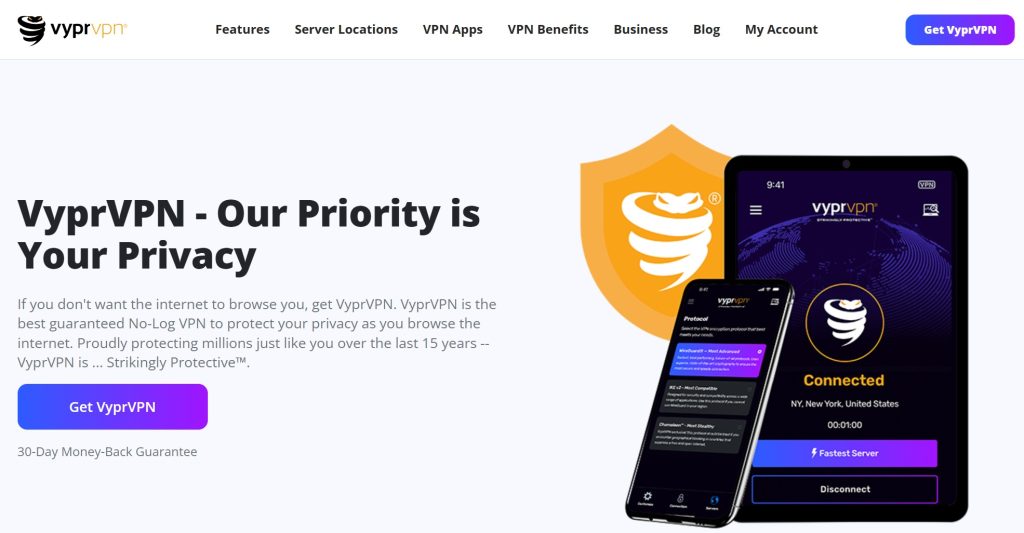
VyprVPN is often considered when you want an extra layer of resilience on restrictive or difficult networks. If you travel frequently and sometimes run into blocked connections, VyprVPN is commonly tested in that “bypass-focused” category.
How to choose the best VPN for Buffalo (a practical checklist)
- Pick your architecture first: always-on device VPN, router VPN, or a border/travel strategy.
- Prioritize stability over headline speeds: most buffering is a stability problem.
- Enable kill switch + DNS leak protection: especially for hotels and public Wi-Fi.
- Keep a shortlist of servers: 2–3 stable U.S. servers + 1–2 Canada servers if you cross the border.
- Remember streaming reality: availability is never guaranteed and can change anytime.
FAQ
1. Is it legal to use a VPN in Buffalo?
Yes. VPN use is legal in the United States.
2. Will a VPN slow down my internet speed?
It can. Encryption and routing add overhead, but nearby servers and modern protocols usually minimize the impact.
3. What’s the best setup if I travel between Buffalo and Canada?
Keep a simple server shortlist: a nearby U.S. server for “home-region” behavior and a Canada server when you want Canadian app behavior. Avoid random switching.
4. Do VPNs guarantee access to streaming libraries?
No. Streaming platforms can block VPN connections and availability can change over time.
![7 Best VPN for T-Mobile [year]: Secure & Fast Mobile Internet](https://vpntrends.org/wp-content/uploads/2025/02/Best_VPN_for_T_Mobile-150x150.jpg "Using a VPN on T-Mobile")
![7 Best VPN for TextPlus [year]: Secure Access and Privacy](https://vpntrends.org/wp-content/uploads/2025/02/Best_VPN_for_TextPlus-150x150.jpg "Using a VPN with TextPlus")
![7 Best VPN for TextNow [year]: Secure Access and Privacy](https://vpntrends.org/wp-content/uploads/2025/02/Best_VPN_for_TextNow-150x150.jpg "Using a VPN with TextNow")
![7 Best VPN for Alaska [year]: Fast Servers for Alaska IP](https://vpntrends.org/wp-content/uploads/2025/02/Best_VPN_for_Alaska-150x150.jpg "Using a VPN in Alaska")

![7 Best VPN for Boston [year]: Fast Servers for Boston IP](https://vpntrends.org/wp-content/uploads/2025/02/Best_VPN_for_Boston-96x96.jpg)
