
![7 Best VPN for Minnesota [year]: Fast Servers for Minnesota IP](https://vpntrends.org/wp-content/uploads/2025/02/Best_VPN_for_Minnesota.jpg)

Minnesota users rely on the internet for remote work, streaming, online banking, school, and daily browsing—but the challenges are not the same everywhere in the state. In Minneapolis–St. Paul you often deal with dense public Wi-Fi environments (cafés, airports, campuses, co-working spaces), while in more rural areas the issue is frequently consistency: variable last-mile quality, congestion during peak hours, and higher sensitivity to packet loss or jitter on video calls. A VPN (Virtual Private Network) won’t create bandwidth that your connection doesn’t have, but used correctly it can improve privacy, reduce exposure on shared networks, and sometimes improve consistency by preventing certain types of traffic classification and by keeping sessions encrypted end-to-end.
This guide explains what to look for in a Minnesota VPN, how to use it for stable day-to-day performance, and which VPN services are commonly chosen for reliable apps, solid privacy controls, and dependable speeds.
What a Minnesota VPN should do (technical checklist)
If you want a VPN that helps in real Minnesota usage, focus on measurable capabilities rather than marketing claims:
- Leak protection: DNS leak protection and IPv6 leak handling to prevent mixed identity signals and accidental location exposure.
- Kill switch: blocks traffic if the VPN drops, preventing accidental exposure on public Wi-Fi.
- Stable protocols: protocol options that reconnect quickly on mobile networks and roaming Wi-Fi.
- Low jitter under load: stable latency for video calls and gaming, not just peak download speed.
- Good U.S. server footprint: so you can choose nearby endpoints (often Midwest hubs) for a better latency-to-stability balance.
For Minnesota specifically, a practical default is to use nearby U.S. endpoints rather than distant regions. A closer endpoint usually means lower latency and fewer performance surprises. If your VPN supports multiple protocols, it’s also worth testing which option reconnects fastest when moving between Wi-Fi and mobile data.
Why Minnesotans use VPNs
1) Public Wi-Fi in the Twin Cities and on campus networks
Minneapolis–St. Paul has high public Wi-Fi density: cafés, libraries, stadiums, hotels, airports, and university networks. Shared networks can be risky because you don’t control who else is connected or how the hotspot is configured. A VPN encrypts your traffic and reduces exposure to passive monitoring and certain types of interception attempts on open or poorly configured Wi-Fi.
2) Remote work: stable sessions and predictable access
Remote work depends on stable sessions: file sync, video calls, remote desktop, and access to corporate applications. If your network is variable (especially during peak usage), encryption can sometimes prevent selective throttling based on traffic classification. Just as importantly, a VPN with stable reconnection and a reliable kill switch can reduce session interruptions when you move between networks or when Wi-Fi quality changes.
3) Banking and account security while traveling
Many services use risk scoring based on device history and IP geolocation. When you travel, extra verification prompts are common. A VPN can help keep sessions private on shared networks, but frequent server switching can also increase account friction. For sensitive logins, consistency is typically more helpful than constantly changing locations.
4) Streaming libraries and sports availability
Streaming libraries and sports availability can vary by region due to licensing and blackout rules. A VPN can provide location flexibility, but the key performance factor is stable throughput with low packet loss. If you stream frequently, look for a provider that holds steady speeds during peak hours rather than one that only posts impressive peak benchmarks.
5) Gaming: latency stability, jitter, and packet loss
Gaming performance is often dominated by jitter and packet loss rather than raw speed. A VPN won’t eliminate distance to a game server, but it can sometimes stabilize routing (or make it worse). The correct approach is to test: compare ping, jitter, and packet loss with and without the VPN to a nearby endpoint. If your baseline route is congested, a VPN may provide a cleaner path; if your baseline is already optimal, a VPN can add overhead.
How to use a VPN reliably in Minnesota
Most VPN issues come from inconsistent usage patterns and avoidable configuration mistakes. A stable operating pattern is:
- Connect the VPN first, then open the app or service you plan to use.
- Pick one nearby region and keep it stable for at least a day.
- Avoid hopping servers repeatedly (it can break sessions and trigger additional account checks).
- Enable kill switch and leak protection.
This matters on public Wi-Fi in particular. If a VPN drops briefly and your device reconnects on your normal network identity, some services can reset sessions or challenge logins. A kill switch reduces that risk. If you encounter captive portals (hotel or airport login pages), complete the portal login first, then enable the VPN for a more stable connection.
How to test VPN performance in Minnesota
To choose a VPN that actually performs well on your connection, test it with repeatable metrics. Use the same device and network, then measure:
- Latency (ping): to a nearby U.S. region and to your most-used services.
- Jitter: variability in latency; high jitter makes calls and games feel unstable.
- Packet loss: even small loss can degrade calls, streaming quality, and gaming.
- Sustained throughput: stable speed over several minutes, not just a peak burst.
- Tunnel stability: whether the VPN drops on Wi-Fi/cellular transitions and during peak congestion.
A practical workflow:
- Test baseline (no VPN) during off-peak and peak hours.
- Connect to a nearby VPN endpoint (often Midwest) and repeat.
- Test 2–3 servers in the same region (do not hop across the country).
- Choose the most stable endpoint and keep it as your default for a week.
If you care about video calls, add a real-world test: run a 15–30 minute call (Zoom/Meet/Teams) and note if audio glitches or reconnects happen. For streaming, test a full episode at your typical peak time. These practical tests often reveal issues that raw speed tests hide.
Reviews: Real Minnesota VPN Experiences
Review 1: A Lifesaver While Traveling to Minnesota
My name is Jessica, I’m 34, and I live in Chicago, Illinois. A few months ago, I had to travel to Minnesota for work, and I didn’t anticipate the restrictions I’d run into. I was trying to access business documents from my company’s cloud server, but they were blocked in some locations during my trip.
At my hotel, the Wi-Fi felt throttled and some services behaved oddly. After researching options, I chose ExpressVPN because I wanted a stable, predictable connection. I connected to a server back in Chicago and it immediately made my work setup feel normal again—files synced, calls ran smoothly, and my sessions stopped dropping.
The main benefit wasn’t a “magic speed boost,” it was consistency and peace of mind when accessing work systems on travel networks.
– Jessica, 34, Chicago, IL
Review 2: Staying Secure While Using Public Wi-Fi in Minnesota
Hi, I’m Ryan, 28, from Duluth, Minnesota. I work as a freelance writer and often use public Wi-Fi in coffee shops, libraries, and co-working spaces. I ignored the risks for a long time until I noticed suspicious pop-ups and connection instability while working downtown.
I installed NordVPN because I wanted encryption and a more secure session on open networks. After connecting, the experience felt more controlled: fewer weird interruptions and less worry about what was happening on the network.
Now I connect before I start work on public Wi-Fi. It has become a basic part of my setup.
– Ryan, 28, Duluth, MN
Review 3: Unblocking Geo-Restricted Content in Minnesota
My name is Emily, I’m 41, and I’m from St. Paul, Minnesota. I like international TV and films, and I kept running into regional restrictions. I tried Surfshark because I needed an easy way to switch regions for specific streaming services.
Setup was straightforward. Once connected to a UK server, content that had been unavailable became accessible. The experience was stable enough to stream without constant buffering, which was the main thing I cared about.
– Emily, 41, St. Paul, MN
Review 4: Protecting My Privacy in Minnesota
I’m Mark, 29, and I live in Minneapolis. I started noticing aggressive tracking and targeted ads that made my browsing feel less private. I chose NordVPN because I wanted a provider known for strong privacy posture and consistent protection on everyday browsing.
After using it routinely, I felt more comfortable browsing and shopping online, especially on shared networks. The practical improvement was fewer “open network” worries and a better sense of control.
– Mark, 29, Minneapolis, MN
Review 5: Avoiding Data Throttling in Minnesota
Hi, I’m Sarah, 45, and I live in Rochester, Minnesota. I noticed that gaming and streaming performance felt worse during peak hours and assumed it was just my ISP. After reading about traffic shaping, I tested ExpressVPN on a nearby endpoint.
Results were better in consistency than in raw speed: fewer spikes and fewer laggy moments during sessions. That made a real difference in day-to-day use.
– Sarah, 45, Rochester, MN
Ensuring Private Browsing in Minnesota With VPN Tools
Minnesota has a strong consumer-protection culture, but legal frameworks do not eliminate technical privacy risks. Advertising and tracking ecosystems collect data at scale, and shared networks introduce additional exposure. A VPN addresses this by encrypting your connection and masking your IP address, reducing how much metadata is visible to intermediaries on the network.
A practical Minnesota factor is how often users rely on shared networks: university Wi-Fi, public libraries, cafés, airports, and hotels. These environments are common targets for opportunistic attacks and configuration problems. A VPN does not solve every risk, but it reduces exposure in the most common scenarios—especially when paired with modern encryption, leak protection, and a kill switch.
From a technical perspective, VPNs use protocols such as OpenVPN, IKEv2, and WireGuard to secure data transmission. WireGuard-style implementations often reconnect faster and handle roaming better, which is useful if you move between Wi-Fi and mobile data. Regardless of protocol, leak protection (DNS/IPv6) and kill switch behavior are the features that most directly prevent accidental exposure.
Best VPN Services for Minnesota
The providers below are widely used services with stable client apps and practical privacy features. Each listing includes one reference link to the provider’s site.
NordVPN

NordVPN is a strong Minnesota option for users who want a mainstream service with a large U.S. footprint. A larger footprint helps you choose nearby endpoints for lower latency while maintaining strong encryption and consistent app behavior. If you use public Wi-Fi frequently, stable tunnel behavior and leak controls are often the most practical day-to-day benefits.
NordVPN supports AES-256 encryption and promotes a strict no-logs policy.
You can read more about NordVPN here:
NordVPN official website
ExpressVPN

ExpressVPN is often chosen for reliability across devices and networks. For Minnesota travel and public Wi-Fi usage, stable tunnel behavior can reduce session drops and minimize the chance of accidental exposure if the network is unstable. For work, that can translate into fewer interruptions on calls and fewer “reconnect” moments on remote tools.
ExpressVPN uses strong encryption and includes a kill switch, which helps prevent traffic from leaking if the VPN disconnects unexpectedly.
You can read more about ExpressVPN here:
ExpressVPN official website
CyberGhost

CyberGhost is a practical option if you want an easy setup and predictable operation. The best results typically come from selecting a nearby U.S. endpoint and keeping it stable rather than switching locations frequently. This “keep it consistent” approach tends to reduce troubleshooting and improves reliability for everyday browsing and streaming.
You can read more about CyberGhost here:
CyberGhost official website
Surfshark

Surfshark is a feature-rich option that can work well for households with multiple devices. For Minnesota performance, prioritize nearby endpoints to keep latency reasonable. If your main use case is streaming, test a few close servers during peak time and keep the one with the most consistent playback.
You can read more about Surfshark here:
Surfshark official website
Private Internet Access (PIA)

PIA is useful for users who prefer configurability and privacy tooling. If you want to tune behavior for complex networks or reduce “mixed routing,” features like DNS leak protection help keep your browsing consistent. For some users, the ability to adjust settings is also helpful when moving between home networks and travel Wi-Fi.
You can read more about Private Internet Access here:
PIA official website
IPVanish

IPVanish is a solid choice if you want a straightforward app experience and dependable performance for general browsing and streaming. For Minnesota, using a nearby endpoint typically delivers the best stability. If you notice buffering or call instability at peak times, test a couple of nearby servers in the same region instead of jumping to distant locations.
You can read more about IPVanish here:
IPVanish official website
VyprVPN
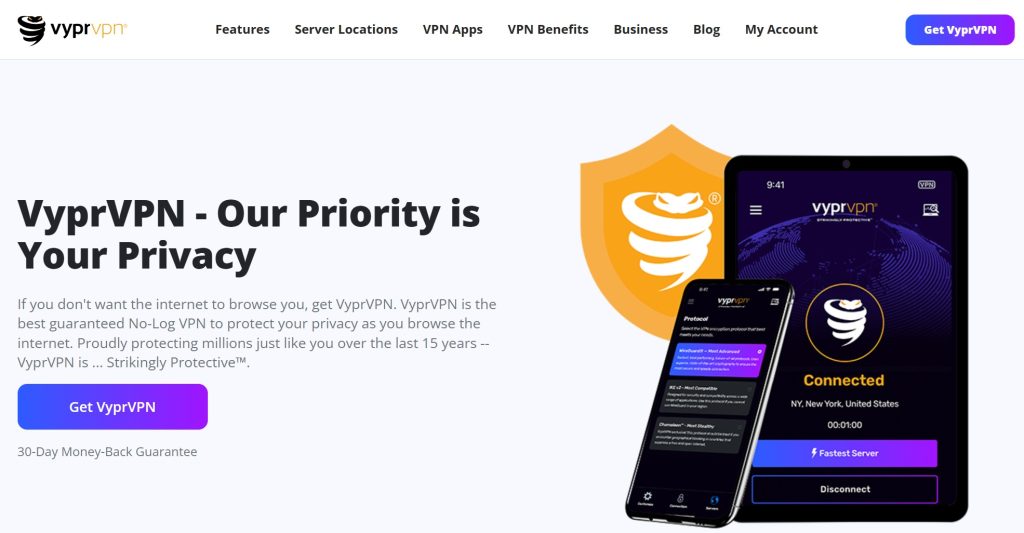
VyprVPN can be useful if you encounter restrictive networks or aggressive filtering on certain Wi-Fi systems. For travel scenarios, stable connectivity on hotel and public networks can matter more than peak speed. If your VPN is primarily for travel safety, stability and reconnection behavior are often the deciding factors.
You can read more about VyprVPN here:
VyprVPN official website
How to Choose the Best VPN for Minnesota
- For public Wi-Fi: prioritize kill switch + leak protection, then keep one stable endpoint.
- For remote work: prioritize stable sessions and low packet loss over peak speed.
- For streaming: prioritize sustained throughput; test 2–3 nearby servers.
- For gaming: prioritize jitter and packet loss; compare baseline vs VPN to a close endpoint.
A simple strategy that works well in Minnesota is to choose a nearby U.S. server region and keep it stable. Frequent switching tends to reduce reliability and can trigger additional verification on sensitive services.
Frequently Asked Questions
1. Is it legal to use a VPN in Minnesota?
Yes. VPNs are legal in Minnesota and across the United States. However, using a VPN does not make illegal activity legal.
2. Can a VPN improve my internet speed?
A VPN can sometimes improve consistency if your ISP applies traffic shaping based on traffic classification, but it can also reduce peak speed due to encryption overhead. The most reliable benefits are privacy and safer use of public networks.
3. Will a VPN help me access content blocked in Minnesota?
A VPN can help you access geo-restricted content by changing the apparent region of your connection. Results depend on the service and on the VPN endpoint you choose.
4. What VPN server location is best for Minnesota?
Nearby U.S. regions are usually best for latency and stability. If you are in Minnesota, choosing Midwest or nearby U.S. endpoints typically provides a better experience than far-away servers.
![7 Best VPN for Alaska [year]: Fast Servers for Alaska IP](https://vpntrends.org/wp-content/uploads/2025/02/Best_VPN_for_Alaska-150x150.jpg "Using a VPN in Alaska")
![7 Best VPN for GTA 5 Online [year]: Fast Servers for Gaming](https://vpntrends.org/wp-content/uploads/2025/02/Best_VPN_for_GTA_5_Online-150x150.jpg "Using a VPN for GTA Online")
![7 Best VPN for Houston [year] Get a Houston IP](https://vpntrends.org/wp-content/uploads/2025/02/Best_VPN_for_Houston-150x150.jpg "Using a VPN in Houston")
![7 Best VPN for Idaho [year]: Fast Servers for Idaho IP](https://vpntrends.org/wp-content/uploads/2025/02/Best_VPN_for_Idaho-150x150.jpg "Using a VPN in Idaho")

![7 Best VPN for Milwaukee [year]: Fast Servers for Milwaukee IP](https://vpntrends.org/wp-content/uploads/2025/02/Best_VPN_for_Milwaukee-96x96.jpg)
![7 Best VPN for Nashville [year]: Fast Servers for Nashville IP](https://vpntrends.org/wp-content/uploads/2025/02/Best_VPN_for_Nashville-96x96.jpg)